02.02 / WRIST & LIGAMENT INJURIES
Wrist Instability
& Sprains
A wrist should move with control and accept load with confidence. When that changes after a fall, a twist or repeated strain, careful assessment helps distinguish a recovering sprain from a problem with stability.

01 / MOVEMENT BETWEEN THE CARPAL BONESControl & coordination
Wrist
Instability
What it is
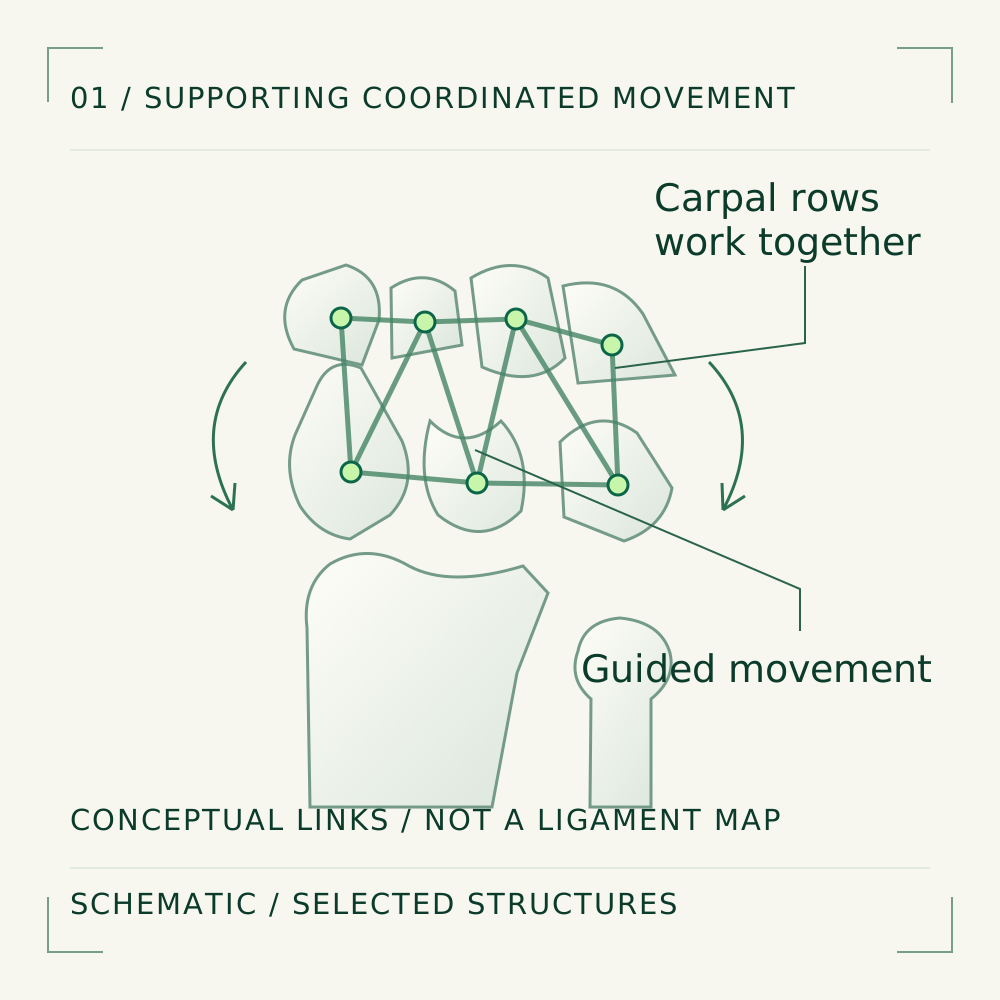
Eight carpal bones form two rows at the wrist. Their joints and ligament supports allow coordinated movement as load passes from hand to forearm. Wrist instability means that this coordination or alignment is disturbed. It describes a mechanical problem with several possible patterns, rather than one single ligament diagnosis.
1What loading can reveal
The wrist may ache when pushing out of a chair, gripping firmly or bearing weight during sport. Some people notice a painful shift or clunk, reduced grip or reluctance to rely on the hand. Symptoms can be intermittent when abnormal movement occurs only in certain positions.
2Different routes to instability
Trauma can disrupt ligament support. Other patterns develop gradually, sometimes in association with ligament laxity or altered mechanics after an older injury. Instability between the scaphoid and lunate differs from midcarpal instability between the rows; identifying the pattern matters for treatment.
3An injury history is useful, but not essential
Some people recall a fall or forceful sporting injury; others cannot identify a starting event. Naturally flexible wrists may have more movement without a painful disorder. The aim is to distinguish symptomatic instability from normal variation, rather than treating flexibility as a diagnosis.
3At rest and during movement
Some changes are visible even at rest. Others appear only when the wrist is loaded or moves through a particular arc. Your account of the provoking task helps the specialist decide whether a dynamic assessment is useful. Do not repeatedly force a painful shift to demonstrate it.
4Understanding the problem.
Choosing the next step.
A focused mechanical examination
The specialist assesses alignment, tenderness, range, grip and movement through the positions associated with symptoms. Findings may be compared with the opposite wrist. Selected clinical manoeuvres help identify the affected joint or ligament system; examination also checks for tendon or nerve problems that can mimic instability.
3Imaging chosen for the question
X-rays assess resting alignment, and stress views or dynamic fluoroscopy may show abnormal movement under load. MRI or arthrographic imaging can assess selected ligament or cartilage questions. CT is useful for particular bony or alignment concerns. Test choice depends on the suspected pattern; advanced imaging is not automatic.
45Teaching the wrist to work together
An appropriate splint and changes to provoking activities may provide initial support. Hand therapy then develops controlled movement and strength without repeatedly stressing a painful wrist.
Proprioception means the sense of joint position. A therapist may use gradual coordination and strengthening work to improve muscular support around the carpal bones. Exercises and progression are individual: a programme suitable for one instability pattern may not suit another.
6When stabilisation enters the discussion
Surgery may be considered for a defined, symptomatic instability that persists despite suitable rehabilitation, or for an injury where early repair is indicated. Repair, reconstruction and other stabilising procedures address different patterns. Cartilage condition and chronicity affect the choice; surgery is not a universal answer to clicking.
13Rebuilding capacity for work and sport
After protection, movement control is restored before heavier resistance and weight-bearing are increased. Your therapist tracks pain, coordination and useful strength. Surgical treatment adds a period of tissue healing and sometimes immobilisation. Return to sport or manual work is based on safe performance of the required tasks, not a calendar alone.
6When the wrist keeps giving way
Arrange review for recurrent painful shifting, loss of grip or a wrist that limits ordinary loading despite an appropriate recovery period. Persistent symptoms after trauma can represent a ligament problem even when an initial X-ray showed no fracture.
702 / AFTER A FALL OR TWISTProtection & reassessment
Wrist Sprain
& Chronic Injury

What it is
A wrist sprain is an injury to one or more ligaments, ranging from overstretching to a partial or complete tear. The word describes a spectrum, not a guarantee of a minor injury. A fracture can also resemble a sprain, so the original mechanism and examination matter.
8What an injured ligament can feel like
Swelling, tenderness, bruising and pain with movement or grip are common. A more significant injury may cause painful clicking or a sense of instability. Mild swelling does not reliably indicate a mild injury, and a wrist that remains painful under load may need another assessment.
8Falls, sport and sudden twists
Landing on the hand, a sporting collision or a forceful twist can stretch the ligaments beyond their tolerance. The hand’s position and the direction of force influence which structures are affected. Injury can occur in everyday activity as well as competitive sport.
8When healing is not following the expected course
Anyone can sustain a sprain. Some remain sore for weeks, but continuing focal tenderness, weakness or failure to regain function should prompt review. Symptoms persisting after a seemingly minor injury may reflect a deeper ligament injury or another cause; duration alone cannot identify it.
10Protect early, then restore useful movement
Early swelling and pain may limit activity. A temporary reduction in load, elevation and a suitable support can help. Comfortable finger and elbow movement helps avoid unnecessary stiffness. Recovery should include a plan for gradually resuming tasks rather than either forcing through pain or resting indefinitely.
11Understanding the problem.
Choosing the next step.
Checking what was injured
Assessment reviews how the wrist was hurt, focal tenderness, swelling, movement and stability. A clinician checks for signs of a fracture or a more substantial ligament injury. If symptoms change or fail to improve, a repeat examination can be more informative than continuing with the original label.
8A normal first X-ray is not the whole answer
X-rays show fractures and alignment but do not directly show most ligament injuries. When suspicion remains after a normal or uncertain film, follow-up X-rays, MRI or CT may be selected according to the clinical question. Protection may be needed while a possible occult fracture is being excluded.
5A plan for protection and rehabilitation
Many uncomplicated sprains improve with short-term support and adjustment of painful tasks. A clinician can advise suitable pain relief. As comfort permits, motion and grip are restored progressively; hand therapy can guide this if stiffness or weakness persists. Splints are reviewed and reduced when safe so protection does not become unnecessary prolonged immobilisation.
10An operation treats a demonstrated injury
A mild sprain does not usually need surgery. A confirmed complete tear with important instability, an associated injury or a chronic ligament problem that remains disabling may need specialist treatment. Repair or reconstruction is considered for the specific structure and pattern, rather than for persistent pain without an established target.
1Improvement should be progressive
Mild injuries may settle over a few weeks; substantial ligament injuries and chronic symptoms can take longer. Return first to comfortable light tasks, then increase lifting, grip and sporting load in stages. If pain repeatedly returns or function plateaus, the plan and diagnosis should be reviewed rather than simply extending rest.
10When to seek prompt help
Seek specialist assessment for continuing focal pain, repeated clicking with pain or difficulty resuming normal use. After an injury, severe pain, an altered wrist shape, inability to move or grip, loss of sensation or a change in hand colour needs urgent assessment.
12THE NEXT CHAPTER / YOUR CARE
A steadier wrist starts with understanding it.
Persistent pain, weakness or a sense of giving way deserves a careful assessment. Together, examination and relevant imaging guide a practical plan for recovery.
Book a Consultation