02.01 / WRIST & LIGAMENT INJURIES
TFCC &
Scapholunate Injuries
Small structures make confident movement possible. When the wrist’s supports are injured, pain, clicking and weakness can interrupt grip and rotation. Understanding which structure is involved gives treatment its direction.
01 / THE LITTLE-FINGER SIDESupport & rotation
TFCC
Injury
What it is
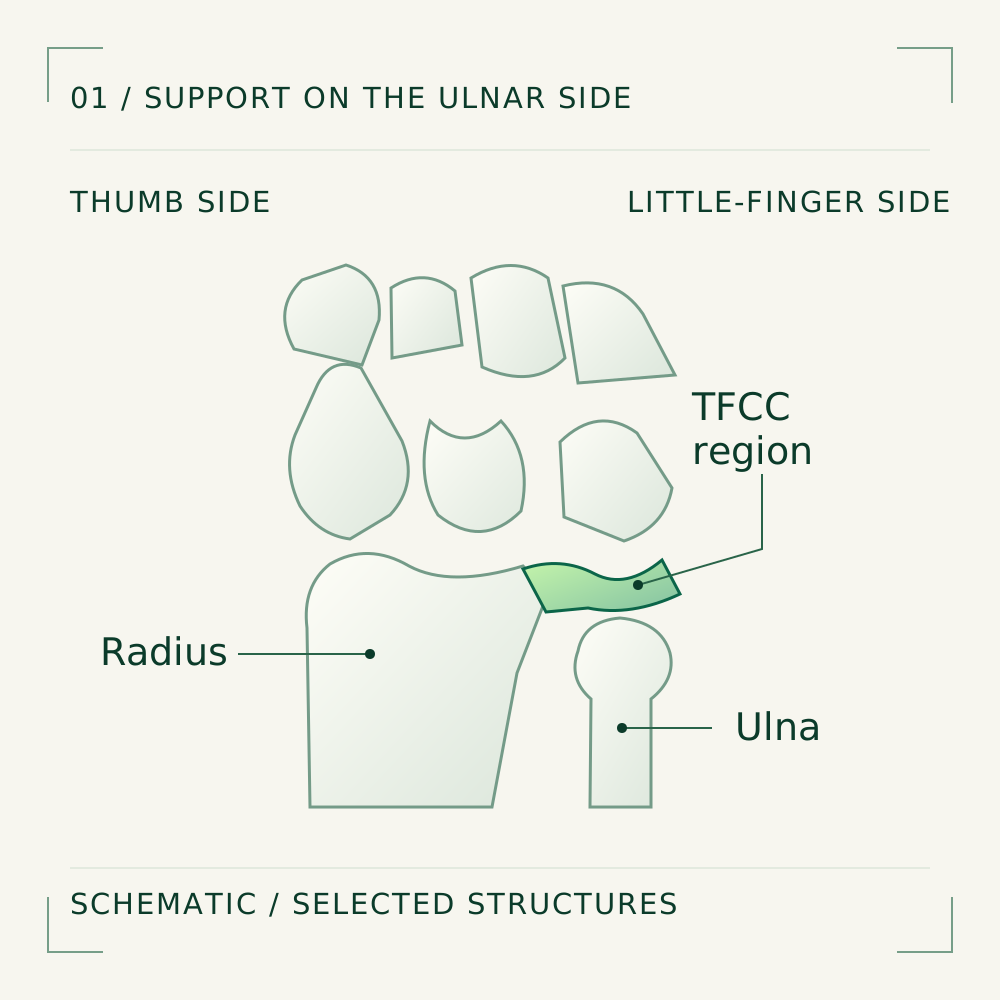
The triangular fibrocartilage complex, or TFCC, is a group of cartilage and ligament structures on the little-finger side of the wrist. It cushions load and helps stabilise the joint between the ends of the radius and ulna, allowing the forearm to turn while the wrist remains supported.
1What you might notice
Discomfort is often felt beside the prominent bone on the little-finger side of the wrist. It may be accompanied by swelling or a weaker grip.
- Pain when turning a key, opening a jar or rotating the forearm.
- Clicking, catching or a sense that the wrist is less secure.
- Pain during forceful gripping or loading the hand.
How the injury happens
A fall onto the hand, a forceful twist or a sudden load during sport can injure the TFCC. It may also be affected alongside a wrist fracture. Repeated loading can contribute to wear-related changes rather than a single memorable injury.
1Traumatic and wear-related problems
Athletes and people whose work involves repeated gripping or rotation may develop symptoms. TFCC tissue also changes with age. A tear seen on a scan may be an incidental finding: treatment depends on whether the history and examination identify it as the source of trouble.
1When symptoms become clearer
Racquet sports, lifting and twisting tasks can reveal the problem. A wrist that feels reasonable at rest may still hurt under load. Note the movement that brings symptoms on; avoid repeatedly provoking a painful click to test the wrist yourself.
3Understanding the problem.
Choosing the next step.
Finding the source of ulnar-sided pain
Assessment checks the exact area of tenderness, forearm rotation, grip and the stability of the joint between radius and ulna. The specialist also examines surrounding tendons and joints. A painful test alone is insufficient to decide whether a TFCC injury needs surgery.
2What imaging can clarify
X-rays assess bone alignment, fractures and the relationship between the radius and ulna. MRI may help evaluate the TFCC and nearby tissues. Findings are interpreted alongside symptoms. Arthroscopy uses a small camera inside the wrist and is reserved for selected cases when closer inspection or treatment is justified.
4Protecting the wrist, then rebuilding control
A stable injury may be managed with a suitable splint, changes to painful activities and a planned period of protection. Hand therapy then guides comfortable movement and gradual strengthening.
Pain relief or anti-inflammatory treatment may be appropriate after checking suitability. A clinician may consider an injection for selected persistent inflammatory symptoms; it does not mechanically repair a torn ligament. The response is reviewed before increasing load.
3Debridement, repair or another targeted approach
Persistent symptoms or clinically important instability may lead to a surgical discussion. Depending on the tear’s position and tissue quality, arthroscopy may be used to trim unstable tissue or repair a repairable tear. Some wrists require another stabilising or load-adjusting procedure. Risks include stiffness, infection, nerve irritation and incomplete relief; a scan alone does not determine the operation.
41Protection before heavy loading
Recovery differs after a simple arthroscopic debridement and a repair that needs protection while tissue heals. Your team specifies any splint or cast, restrictions on rotation, and the start of therapy. Work and sport resume in stages, guided by the procedure, pain, motion and strength. Heavy gripping and racquet sport may need a longer pause than light tasks.
4When specialist assessment helps
Seek review for continuing little-finger-sided pain, recurrent catching or difficulty returning to ordinary activities. A wrist that feels unstable after an injury deserves earlier assessment. Treatment aims to address the demonstrated problem; not every TFCC finding needs an operation.
202 / THE BACK OF THE WRISTAlignment & stability
Scapholunate
Ligament Injury
What it is
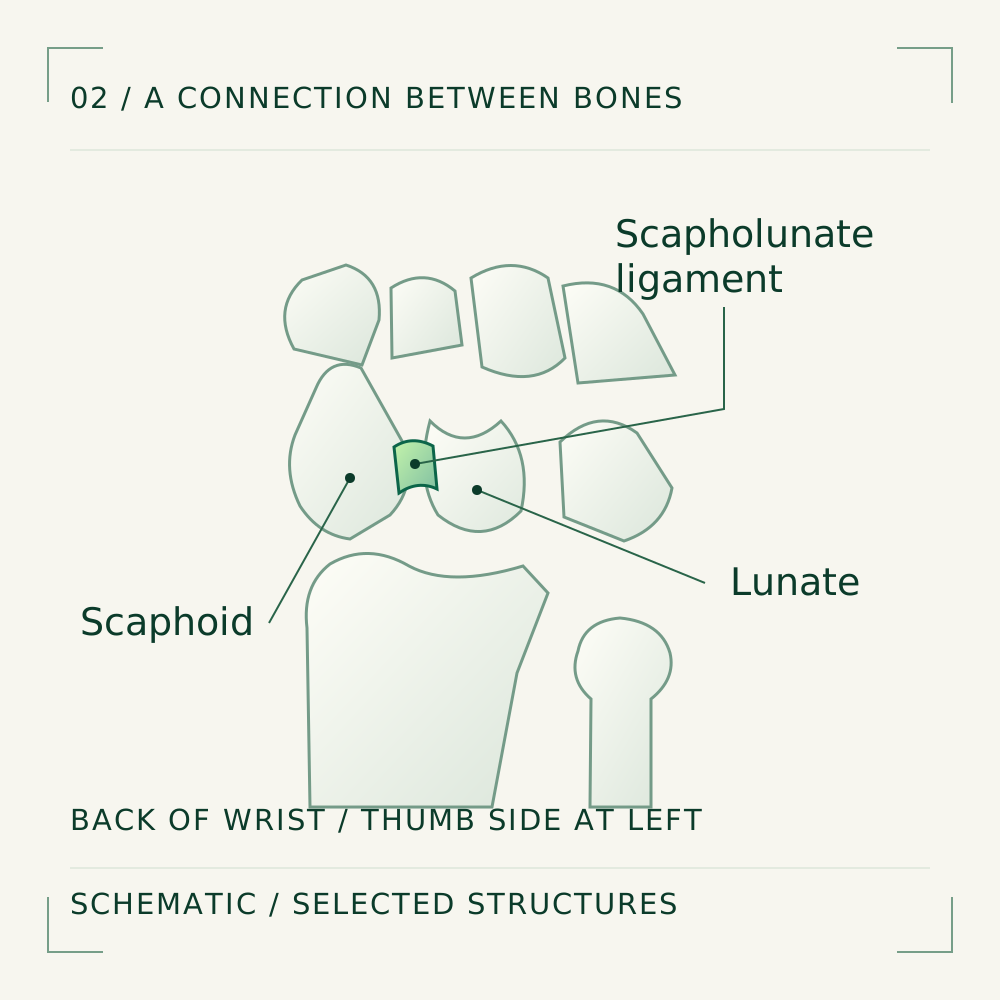
The scapholunate ligament connects the scaphoid and lunate, two small bones in the first row of the wrist. It helps them move in a coordinated way. A significant injury can allow abnormal movement between them, sometimes progressing to a change in the wrist’s overall alignment.
5Pain when the wrist carries weight
Symptoms may include tenderness over the central or thumb-side back of the wrist, swelling, reduced grip and clicking or clunking. Pressing through an extended wrist can be difficult. Some injuries are initially described as a sprain, with instability becoming more apparent later.
2A fall, an impact or a forceful load
A fall onto an outstretched hand can force the wrist beyond its normal range. Sporting injuries and other trauma can also damage the ligament. The seriousness of the injury depends on the ligament and surrounding supports, not simply the amount of visible swelling.
7Recent injury and delayed symptoms
People may present soon after a fall or much later with continuing weakness and loading pain. An apparently normal early X-ray does not exclude a ligament injury. Persistent symptoms after trauma deserve reassessment rather than an assumption that the wrist has fully recovered.
8Why acute and chronic injuries differ
A recent tear may offer different repair options from an established injury with scarring, altered alignment or cartilage wear. The specialist considers how long symptoms have been present, whether the bones can be realigned and the condition of the joint surfaces. Early review preserves the opportunity to discuss suitable options.
5Understanding the problem.
Choosing the next step.
Assessing movement as well as tenderness
The examination looks at swelling, wrist motion, grip and local tenderness. Carefully performed tests assess how the scaphoid behaves as the wrist moves; symptoms and findings are compared with the other side. These manoeuvres need clinical interpretation and are not reliable self-tests.
6Sometimes the change appears only under load
Standard X-rays assess alignment. Stress views, such as a clenched-fist view, or selected moving X-ray studies may reveal instability that is not visible at rest. MRI, MR arthrography or CT arthrography can provide further ligament and cartilage information when indicated. No single scan replaces the clinical assessment.
9When a supported rehabilitation plan is appropriate
For suitable partial or stable injuries, reducing painful loading, splinting and supervised rehabilitation may help. Therapy can improve coordinated muscle support and grip control. Follow-up checks whether symptoms and function are improving; ongoing mechanical instability may need a different discussion.
6Repair, reconstruction and realistic goals
A repairable recent injury may be stabilised with ligament repair and temporary fixation. A chronic injury may require reconstruction; established arthritis can change the options again. Surgery and rehabilitation aim to improve useful function, but normal motion, complete pain relief and prevention of all later degeneration cannot be guaranteed.
5A staged return to load
Protection may include a cast or splint and, in some operations, temporary wires. Hand therapy progresses from permitted movement to strengthening after adequate healing. Recovery is usually measured in months rather than days. Stiffness or some discomfort can remain; return to manual work or sport depends on the procedure and safe function.
8Persistent instability deserves review
Untreated, clinically significant scapholunate instability can alter joint loading and contribute to arthritis over time, although progression varies. Continuing dorsal pain, a painful clunk or loss of grip after a fall warrants specialist review. An early assessment clarifies the injury and the choices available.
8THE NEXT CHAPTER / YOUR CARE
Persistent wrist pain deserves a closer look.
A specialist assessment brings the injury, examination and any imaging together, so protection, rehabilitation or surgery can be considered for the right reason.
Book a Consultation