02.03 / WRIST & LIGAMENT INJURIES
Wrist Ganglion
& Related Problems
Some wrist problems are visible. Others are felt only in movement. A careful examination helps explain a lump or persistent pain, and whether observation, rehabilitation or a targeted treatment is appropriate.

01 / A RELATED WRIST CONDITIONJoint or tendon-sheath connection
Wrist Ganglion
Cyst
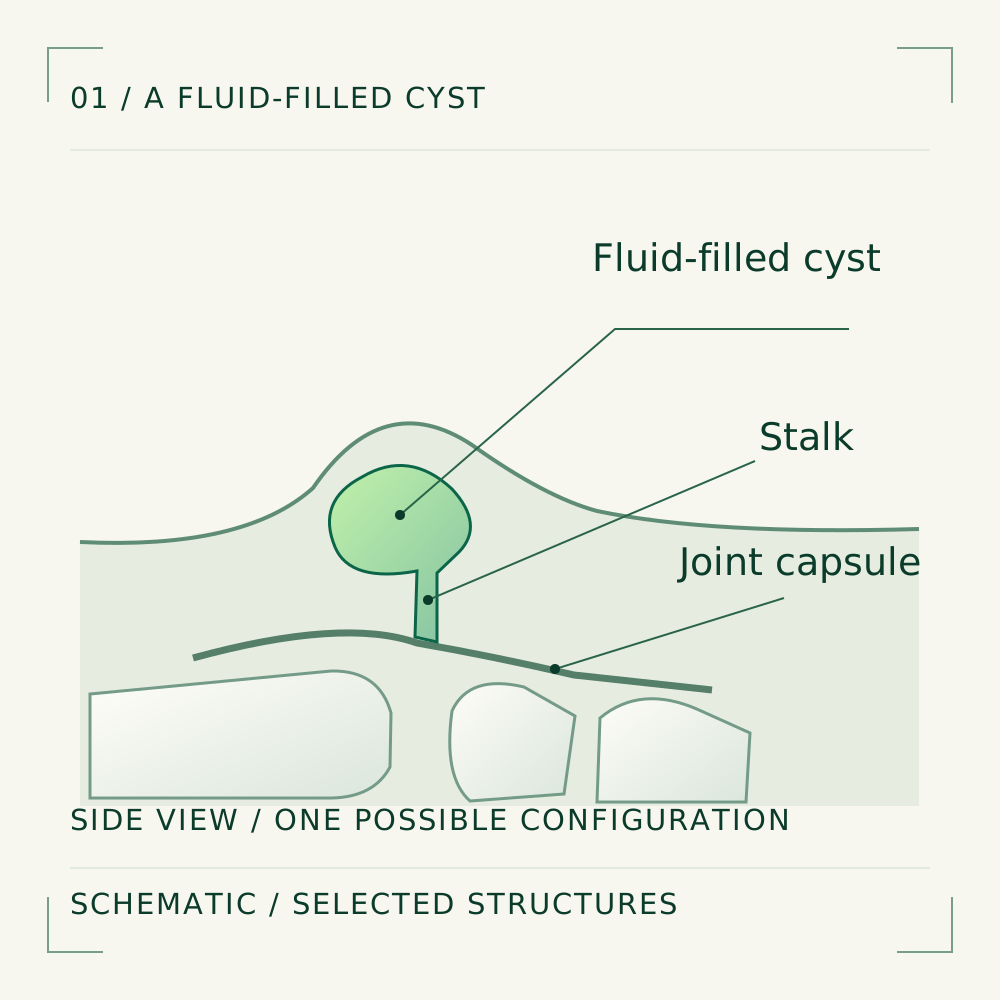
What it is
A ganglion is a benign, fluid-filled cyst that can arise from a joint or tendon sheath. Around the wrist it most often appears on the back, but it can also occur on the palm side. It is included here as a related wrist condition: a ganglion is not itself a ligament tear.
2Visible, variable — sometimes painless
A lump may become more or less noticeable and can change size. Some ganglia cause discomfort with pressure or wrist loading; others are painless. If a cyst presses on a nearby nerve, tingling or weakness can occur. A small, deeper ganglion may not be visible at the surface.
2Where the fluid-filled swelling begins
A ganglion often has a narrow connection to a joint capsule or tendon sheath. The exact reason it develops is not always clear. A preceding injury may be reported, but many arise without an obvious event; finding a cyst does not establish an underlying ligament tear.
3Not only a sporting problem
Ganglia can affect different ages and activity levels. They are commonly seen in younger adults and are more frequent in women. Some are associated with joint wear or prior injury, but neither is necessary. A person can have a ganglion and otherwise normal wrist function.
2Back and palm side need different care
Understanding the problem.
Choosing the next step.
Examining the lump
The specialist asks how long it has been present, whether its size changes and what brings on pain. Examination assesses its location, consistency and effect on movement. If a lump is atypical, firm, growing or otherwise uncertain, further assessment is needed before calling it a ganglion.
4When a scan is helpful
Many ganglia are recognised clinically. Ultrasound can help distinguish a fluid-filled cyst from a solid lump and show nearby structures. MRI may be useful for a small hidden cyst or an uncertain diagnosis. X-rays are sometimes used to assess an associated bone or joint problem; they do not show the cyst itself.
1Observation and selected aspiration
A confirmed, painless ganglion can often be observed; some shrink or disappear. Changing aggravating activities or using a support briefly may ease discomfort. Prolonged bracing without a reason can contribute to weakness.
Aspiration removes fluid through a needle in suitable cases, usually more readily for a dorsal cyst. The connection remains, so recurrence is common. Palm-side cysts need particular caution because of adjacent vessels and nerves.
43When removal is considered
Excision may be discussed for continuing pain or functional difficulty when appropriate non-surgical options have not helped. The cyst and its connection are addressed, using an approach suited to its location. Surgery can still be followed by recurrence, scar sensitivity, stiffness or persistent pain; nearby nerve or vessel injury is another consideration.
3Returning to comfortable use
After excision, wound healing and comfort guide the early return to light activity. Your team advises any support, movement and later strengthening. Heavy lifting, sport and manual work may need longer than desk tasks. Recovery varies with the location, procedure and individual response; removing a cyst does not guarantee that every wrist symptom will disappear.
1When a lump deserves review
Arrange assessment for a new or changing lump, persistent pressure pain, tingling or loss of function. A rapidly enlarging, hard or atypical mass should not simply be assumed to be a ganglion. Seek urgent care if a swelling becomes hot and very painful, especially with redness or fever.
1102 / WHEN THE EXPLANATION IS LESS OBVIOUSA symptom-led assessment
Related Wrist
Soft-Tissue Problems

What it is
Persistent wrist pain without an obvious fracture can have several explanations: tendon irritation, joint or capsular inflammation, a small ganglion, or an injury not apparent on the first examination. Sometimes no single structural cause is identified. This chapter describes an assessment pathway, not another diagnosis that every painful wrist must have.
6Patterns worth describing
Tell the specialist where the pain is felt, which movements provoke it and whether swelling, stiffness or reduced grip accompany it. Note any lump, tingling or catching. A clear account of function and change over time is more useful than trying to assign a diagnosis from location alone.
8Tendons, capsule and surrounding tissues
Repetitive loading or a minor injury can irritate tendons and the tissues around them. The joint lining may also become inflamed, causing pain with or without obvious swelling. In some people, an inflammatory joint condition contributes. These possibilities require different assessments; they are not interchangeable labels.
9A single accident is not always present
Symptoms may follow a fall, increased sporting load or repetitive work. Others develop gradually, including from arthritis or nerve-related problems. Age, the activity pattern and medical history all help narrow the possibilities. Not every case of continuing pain contains an occult tear.
6What “occult” does — and does not — mean
Occult means not readily apparent. A small ganglion or an injury can occasionally be hidden from view, but the term should not be used as a diagnosis in itself. Further investigation is most helpful when the examination gives a specific question that the result could answer.
7Understanding the problem.
Choosing the next step.
Reassessment without assumptions
The examination considers local tenderness, wrist and tendon movement, strength, sensation and any swelling or mass. It may revisit the original injury and review previous images. Symptoms can come from neighbouring joints or nerves; the aim is to identify a credible explanation before choosing a targeted treatment.
8Choosing useful information
An X-ray is often the first imaging step for persistent wrist symptoms. Depending on the findings, ultrasound may help evaluate a tendon or lump, MRI may assess deeper soft tissues, and CT may clarify a bony question. A specialist relates any finding to the examination; more imaging does not necessarily provide a more useful answer.
7A proportionate plan for recovery
Treatment may include modifying the aggravating load, a time-limited support and suitable pain relief, followed by guided movement and strengthening. The plan is adjusted to the suspected or established problem. Review points help ensure that persistent symptoms are reassessed instead of simply repeating treatment without a clear benefit.
10Only when there is a reasoned target
An operation is not the default response to unexplained wrist pain. Surgery may help a defined problem, such as a symptomatic cyst or a significant confirmed tissue injury, after its benefits and risks are considered. When the source remains uncertain, further assessment or continued non-surgical care may be more appropriate.
8Follow function as well as pain
Soft-tissue recovery varies with the tissue involved and the demands placed on it. Gradual progress in comfortable motion, grip and daily tasks is useful. Recurring swelling, worsening weakness or a plateau should trigger a review of the plan. A fixed recovery date is rarely helpful before the cause and severity are understood.
10When to seek another assessment
Book a review if pain persists, repeatedly returns with ordinary activity or limits work and sport. New numbness, progressive weakness or an enlarging lump also deserves attention. After trauma, severe pain, deformity, a cold or discoloured hand, or loss of sensation requires urgent assessment.
5THE NEXT CHAPTER / YOUR CARE
A lump or lasting wrist pain deserves a clear explanation.
Specialist assessment can establish what needs attention and what can safely be observed, with treatment guided by your symptoms, examination and relevant imaging.
Book a Consultation