05.01 / ARTHRITIS & JOINT DISEASE
Thumb & Finger
Arthritis
Pinching a key. Holding a pen. Closing the hand. Arthritis can change the ease of these familiar movements. Understanding which joint is affected helps make treatment specific to the hand and the person using it.

01 / WHERE THE THUMB MEETS THE WRISTThe carpometacarpal joint
Thumb Base
Arthritis
What it is
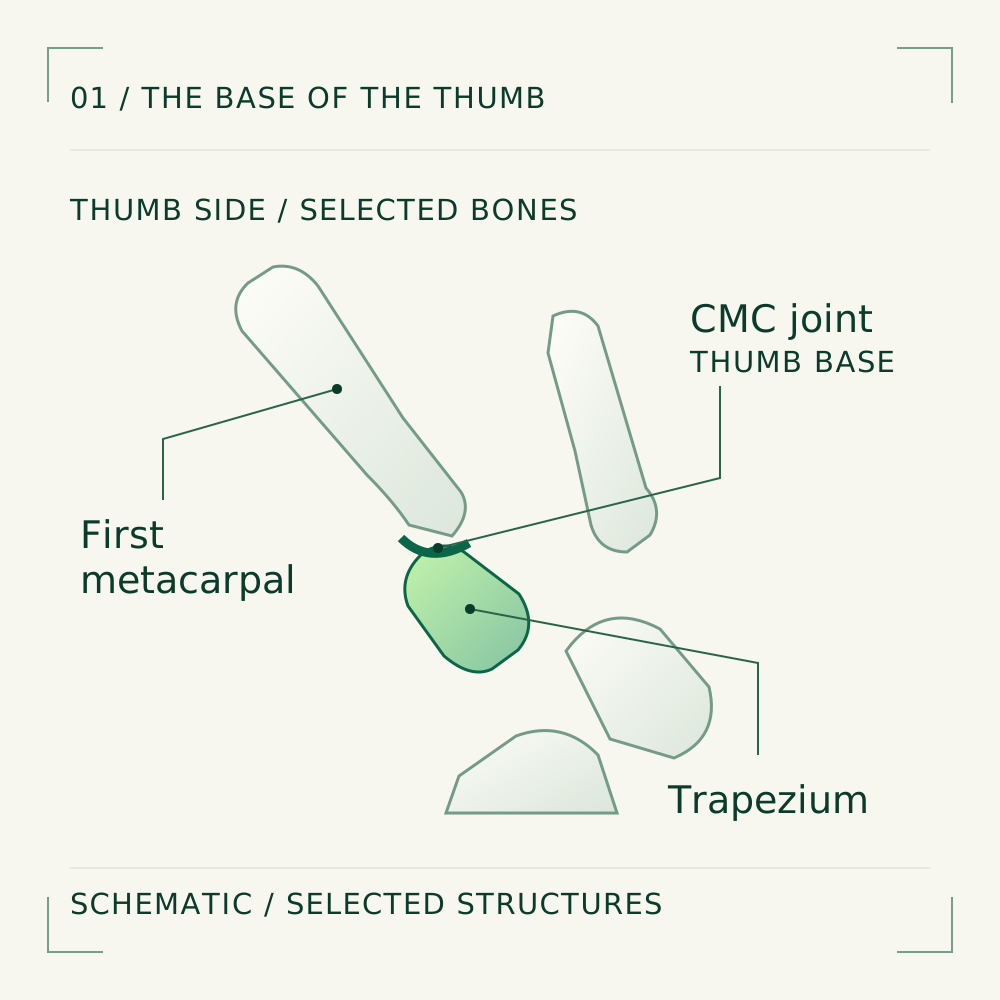
The thumb’s basal, or carpometacarpal (CMC), joint sits between the first metacarpal and a wrist bone called the trapezium. It allows the thumb to turn towards the fingers. Osteoarthritis changes the smooth cartilage covering these joint surfaces, making pinch and grip uncomfortable.
1Pinching, gripping and turning a key
Pain is usually felt around the fleshy base of the thumb. Opening a jar, turning a key or holding a pen may hurt. Swelling, reduced movement and weaker pinch can develop; some people notice a bony prominence or a change in the thumb’s posture.
1Cartilage change and joint support
Joint shape, inherited susceptibility and ligament support can contribute. Previous injury may alter how the surfaces meet. Osteoarthritis is a joint condition, different from irritation of the thumb-side tendons.
2A common problem with variable progression
Basal thumb arthritis becomes more common with age, particularly in women. Progression varies. In advanced cases the thumb can draw towards the palm and the next joint bend backwards; not everyone develops this pattern.
2Repeated force can make symptoms more noticeable
Sustained pinch, tightly gripping a small handle or repeatedly twisting a lid can aggravate a sensitive joint. A therapist may suggest larger handles, opening aids or a different grasp. The aim is to make useful activity more manageable, rather than stop using the hand altogether.
3Understanding the problem.
Choosing the next step.
Locating the source of pain
Assessment checks tenderness, movement, stability and pinch, and considers nearby tendons or other joints. The clinician may gently load and move the basal joint to reproduce the familiar pain. Describe the tasks that matter most, including work, hobbies and personal care.
2What an X-ray adds
X-rays can show narrowing of the joint space, bony spurs and changes in alignment. They help establish the pattern and extent of arthritis. The findings are interpreted alongside symptoms because the amount of visible change does not reliably describe how troublesome the hand feels.
1Support and practical changes first
A thumb support may reduce painful loading while allowing useful movement. Hand therapy can guide comfortable exercises, joint protection and modifications to daily tasks. The type of splint and when to wear it are individual choices; forceful squeezing exercises are not automatically helpful for an irritable basal joint.
3Pain relief matched to your health
Topical anti-inflammatory treatment may help some people. Tablets require consideration of other medicines and stomach, kidney or cardiovascular problems. A clinician or pharmacist can advise what is suitable; medication supports function but does not replace the joint’s lost cartilage.
4A possible period of symptom relief
A corticosteroid injection may be considered when symptoms remain troublesome. Benefit varies and may be temporary. Discuss the likely value and injection risks; an injection is neither a guaranteed alternative to surgery nor a cure for arthritis.
2Considering an operation when function remains limited
One established option is trapeziectomy: removing the trapezium to address the painful articulation. Additional support using nearby tissues may be used. Other procedures suit selected circumstances. The choice follows assessment and discussion of the expected benefit, limitations and risks, including persistent pain, stiffness and reduced strength.
5Other options for selected thumbs
Fusion deliberately stiffens the joint. Joint replacement aims to retain movement. Both have specific indications and limitations, so selection depends on the individual thumb and the person’s needs.
2Protection, then gradual use
After surgery, dressings or a splint protect the area before movement and functional use increase according to the surgical plan. Rehabilitation may include hand therapy. Swelling and tenderness can take months to settle, and improving comfort does not guarantee stronger pinch or a return to every activity.
5When everyday tasks keep becoming harder
Specialist review is reasonable when pain, weakness or deformity interferes with daily use despite appropriate support and activity changes. Discuss which movements you need, how much time rehabilitation may require and what improvement is realistic before deciding whether an operation is worthwhile.
502 / THE TIP, MIDDLE AND KNUCKLE JOINTSComfort, alignment & dexterity
Finger
Arthritis
What it is
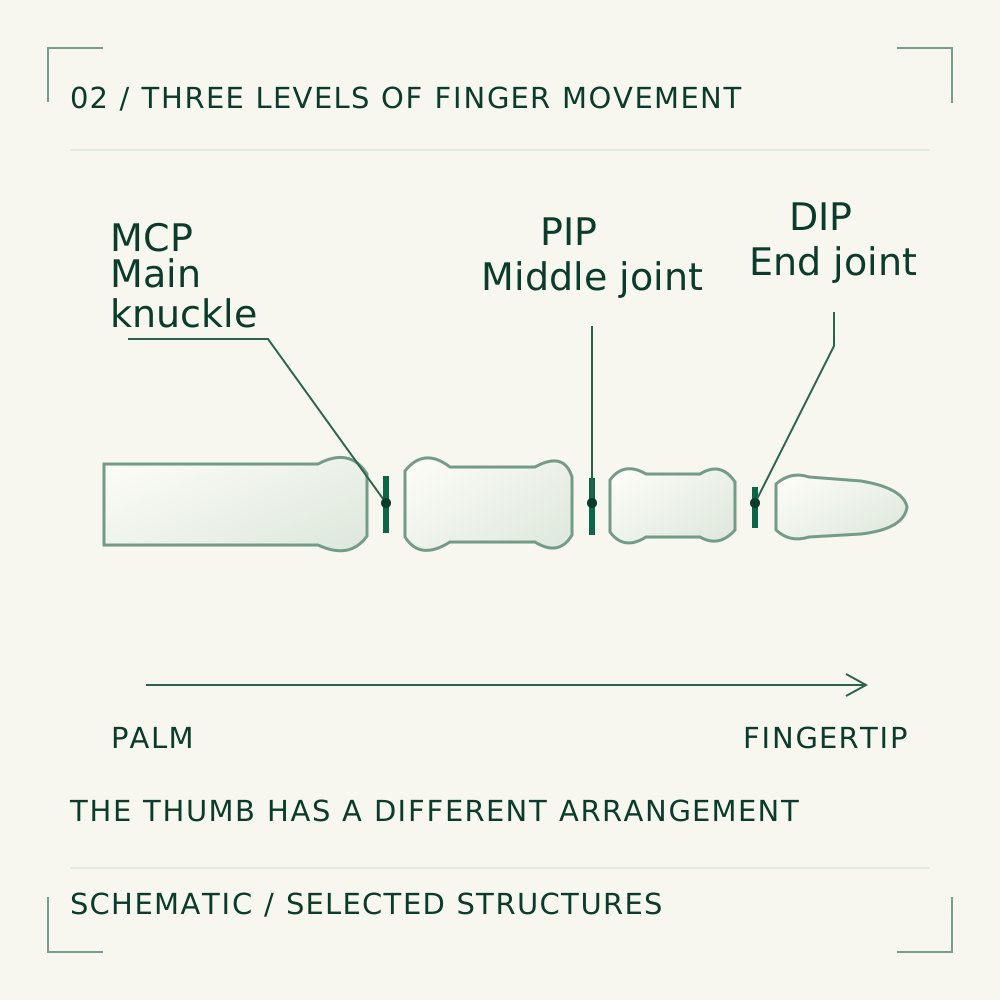
Finger arthritis affects the surfaces where the finger bones meet. Osteoarthritis commonly involves the end joint (DIP) and middle joint (PIP). The main knuckles (MCP joints) are less typical sites for primary osteoarthritis, so inflammation or previous injury may need consideration.
6Pain, swelling and loss of ease
Affected joints may ache, feel stiff after rest or become tender during a flare. Bony enlargements can appear near the fingertip, and movement may gradually reduce. Symptoms vary over time; a visibly enlarged end joint does not necessarily remain painful indefinitely.
7Wear, previous damage and inflammation
Osteoarthritis involves cartilage change and a response from the surrounding bone and tissues. A previous joint injury can contribute to later degeneration. Inflammatory arthritis is a different process and needs recognition; not every swollen or crooked finger should be labelled ordinary wear.
6Age and family history play a part
Hand osteoarthritis becomes more common with age and may run in families. Middle-joint nodules are called Bouchard’s nodes and end-joint nodules Heberden’s nodes. These describe bony changes.
6Small movements can have a large impact
Buttons, writing and holding small objects require coordinated finger movement. Pain and reduced grip make these tasks tiring. Explaining which activities have changed helps identify whether to prioritise comfort, stability or movement.
8Understanding the problem.
Choosing the next step.
Examining the pattern across the hand
Examination checks tenderness, movement, stability and finger alignment during grip. The distribution of swollen joints matters. Blood tests or rheumatology assessment may be appropriate if the findings suggest an inflammatory cause.
6Seeing which surfaces are affected
X-rays can show joint-space narrowing, bony spurs and deformity. They help distinguish patterns and plan a procedure when necessary. More complex scans are not routinely needed for straightforward finger arthritis; an uncertain diagnosis or a particular treatment question may justify further investigation.
8Keeping the hand useful
Care may combine activity changes, hand therapy, suitable pain relief and splinting of selected painful or unstable joints. Supports should address a specific problem. Maintaining comfortable movement matters; avoiding all activity can add weakness and stiffness.
8An option for selected painful joints
A corticosteroid injection may be discussed for a troublesome joint. Relief is uncertain and may not last. Injections are not routinely needed for every arthritic finger; potential benefit is weighed against local risks.
6Movement and stability involve different trade-offs
Fusion joins the bones on either side of a painful joint, giving stability while permanently removing movement at that joint. Replacement aims to retain some movement in selected middle or knuckle joints; end joints are usually fused when surgery is needed. Joint location, tendon balance, bone quality and activity demands influence the choice; neither operation recreates a completely normal finger.
8A plan specific to the operation
After a finger joint replacement, protection and carefully guided exercises work together. A hand therapist may make a splint and help control swelling while movement is gradually introduced. Follow the prescribed programme: unrestricted bending, forceful stretching or heavy gripping too soon can put the reconstruction at risk.
9Rebuilding dexterity takes time
Swelling and stiffness can persist while the hand recovers. Return to heavier activities is guided by healing, the procedure and the demands of the task. After replacement, exercises aim to improve useful movement; a fused joint remains still, with the surrounding joints contributing to hand function.
9Persistent pain deserves a review
Seek specialist advice when an affected joint stays painful, becomes unstable or prevents useful daily activity despite appropriate care. An end-joint fusion may be considered for persistent symptoms, but an enlarged, comfortable joint can often be observed without an operation.
7A sudden hot, swollen joint is different
A joint that rapidly becomes very painful, hot and swollen needs urgent assessment, particularly with fever or feeling unwell. Infection can occur without fever. Do not assume a sudden severe episode is simply the usual arthritis or wait for a routine consultation.
10THE NEXT CHAPTER / YOUR CARE
When stiffness begins to limit everyday movement, the cause matters.
A specialist assessment can connect your symptoms with the underlying problem and help you weigh personalised treatment options, rehabilitation and the movements that matter to you.
Book a Consultation