04.02 / FRACTURES & TRAUMA
Hand & Finger
Fractures
A hand needs more than healed bone: it needs fingers that line up and move together. Fracture location, rotation, joint involvement and soft-tissue injury all help shape a plan for useful recovery.
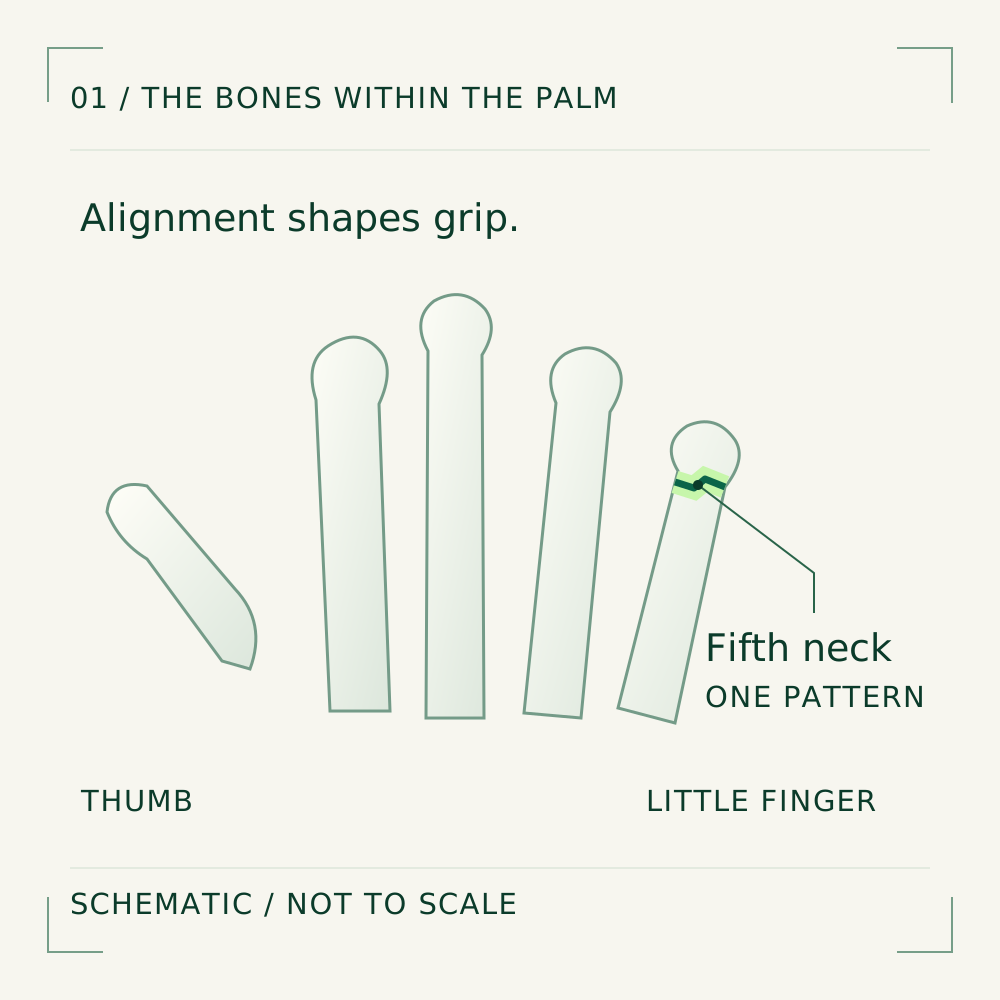
01 / THE BONES WITHIN THE PALMLength, rotation & grip
Metacarpal
Fractures
What it is
The five metacarpals form the framework of the palm, connecting the wrist to the finger and thumb knuckles. A break may affect the base, shaft, neck or head of a metacarpal. The pattern matters because each bone helps position its digit for a coordinated grip.
1Swelling can hide the underlying pattern
Bruising, tenderness, pain with grip and swelling over the hand are common. A knuckle may look flatter or a finger may sit differently. Reduced movement can reflect pain, altered alignment or an associated injury; the outward appearance alone cannot determine the treatment needed.
2Impact, a fall or a twisting force
Sports contact, falls and direct blows can fracture a metacarpal. Punching can break the fifth metacarpal near the little-finger knuckle, often called a boxer’s fracture. A crush or higher-energy impact can involve several bones and the surrounding tissues.
1The same fracture can affect different tasks
Injuries occur during sport, work and everyday accidents. A clinician asks about hand dominance and the grip, lifting or fine-control tasks you need to recover. Those demands help guide protection and rehabilitation, alongside the fracture findings.
2Angle and rotation are different problems
Some angulation may be acceptable in selected metacarpal fractures, depending on the bone and location. Rotation is assessed separately because it changes where the finger points during bending. Loss of knuckle contour can occur, but the priority is a useful finger position and hand function.
2Understanding the problem.
Choosing the next step.
Look at the hand at rest and during movement
Examination checks the skin, tenderness, sensation, circulation and tendon function. When safe, gentle finger bending helps the clinician assess whether the digits line up normally. Associated wounds or injuries to neighbouring bones and joints must also be considered.
1X-rays show more than the break alone
Views from different angles show fracture position, shortening and joint involvement. Follow-up films may check that alignment is maintained. A stable fracture is one likely to remain acceptably positioned during protection; an unstable pattern can shift and may need a different treatment plan.
2Protect the fracture while preserving safe movement
Suitable fractures can be managed with a splint, cast or selected buddy strapping. The team specifies which joints may move and which activities to avoid. Prescribed gentle movement helps prevent stiffness; an apparently comfortable hand is not a reason to resume heavy gripping early.
3Reduction and fixation when alignment needs support
A displaced fracture may first need realignment under suitable anaesthesia. Surgery is considered for unacceptable rotation, instability, certain joint injuries or other complex patterns. Wires, screws or plates can hold the fragments; the method balances stability, soft-tissue protection and the requirements of rehabilitation.
4A protected return to movement
Swelling control, safe tendon glide and movement of permitted joints are important. A hand therapist can adjust exercises and splint use as healing progresses. Doing more than the prescribed programme can overload the injury, while unnecessary prolonged immobilisation can add stiffness.
3Return to grip in stages
Bone healing and recovery of strength are different milestones. Light everyday use may return before heavy manual work, impact or contact sport. The treating team uses fracture stability, tenderness, movement and function to guide progression. Persistent swelling or stiffness may require further therapy.
3When the hand needs prompt review
Arrange prompt assessment after suspected fracture, particularly if a finger overlaps its neighbour or grip has changed. A wound, marked deformity, new numbness or poor finger circulation needs urgent attention.
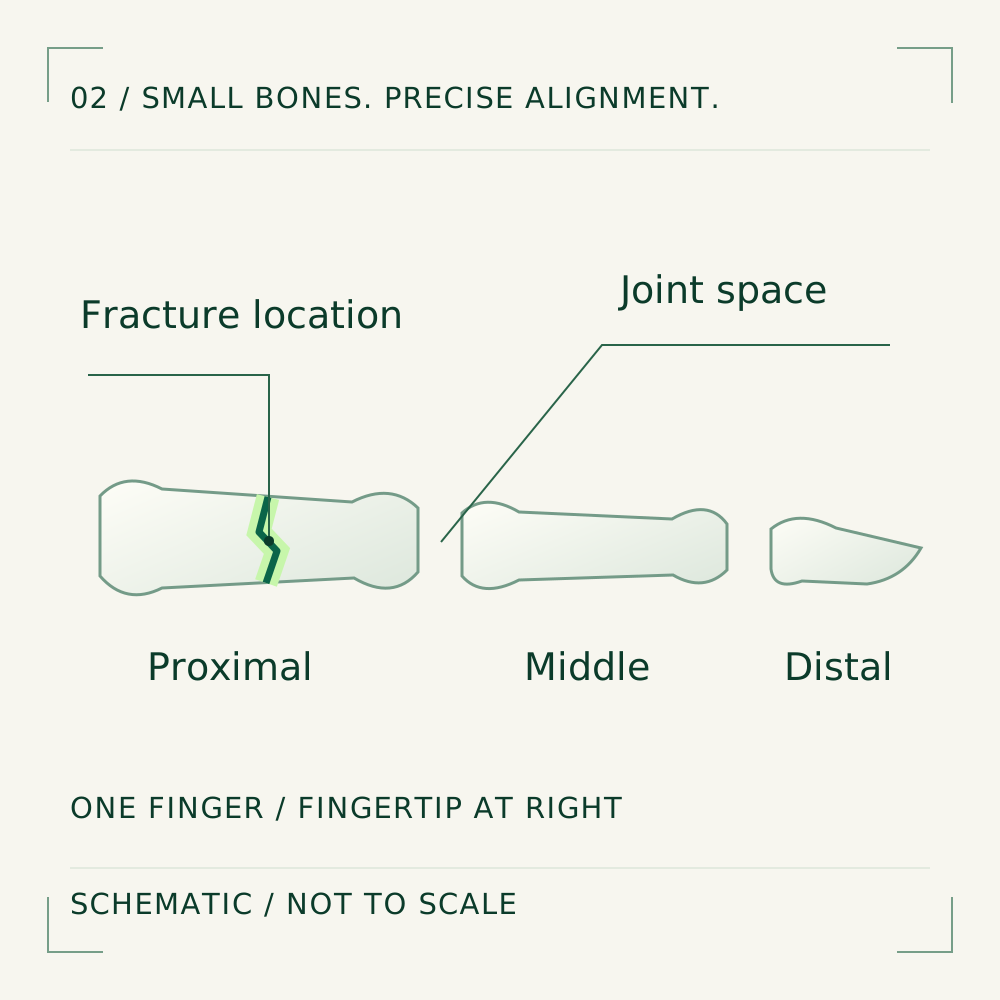
402 / THE BONES OF THE DIGITSJoint alignment & tendon glide
Finger
Fractures
What it is
The finger bones are called phalanges. Most fingers have three; the thumb has two. A fracture can pass through a shaft or into a joint, and a tendon or ligament can sometimes pull off a small fragment. These differences affect both protection and the movement allowed during healing.
5Pain, swelling and a change in finger use
A bruised, tender finger may be difficult to bend or straighten. There may be visible angulation, a changed resting position or overlapping during bending. Significant swelling can make a fracture, dislocation and severe sprain look similar, so assessment is preferable to guessing from appearance.
7Crush, impact and sports injuries
A ball striking a fingertip, a finger caught in a door or machinery, a fall, or a direct blow can break a phalanx. The mechanism also guides checks for nail-bed, tendon and ligament injury. A small fracture can be important when it involves a joint surface.
5A small area can have a large functional effect
Finger injuries occur in daily life, at work and in sport. Precise alignment matters for coordinated grasp and release. Assessment considers the injured digit, the tasks you rely on and whether more than one finger or tissue has been damaged.
8Why a twisted finger needs attention
Rotation means the bone fragments have turned relative to one another. When the finger bends, its tip may point across an adjacent finger instead of following the normal curve of the hand. This can obstruct grip and should be assessed even if the finger appears straighter when extended.
8Understanding the problem.
Choosing the next step.
Assess the bone, joints and soft tissues
Examination checks the finger’s alignment, skin and nail, circulation and sensation. The clinician assesses bending and straightening when appropriate, looking for associated tendon or ligament disruption. A wound may connect to the fracture even when it is small and requires particular attention.
5X-rays guide the initial plan
X-rays identify the site, displacement and any joint involvement. Complex patterns may need additional imaging. Reassessment or follow-up films may be needed because a fracture that looks well aligned initially can move. The stability of the pattern determines how closely it needs monitoring.
5Buddy strapping is an option for selected injuries
Stable, suitably aligned fractures may be treated with buddy strapping or a protective splint. Other injuries require a specific position or longer protection. Do not substitute general exercises or taping advice for the plan given after examination; the treatment must also protect any associated soft-tissue injury.
6Restore position when simple protection is insufficient
A displaced fracture may need reduction with local anaesthesia or another suitable technique. Fixation with wires, screws or plates may be considered when alignment cannot be maintained, rotation persists or the joint requires reconstruction. An operation is chosen for a defined problem, not simply because a finger is broken.
8Limit stiffness without stressing the healing tissues
Hand therapy can guide swelling control, safe movement and later strengthening. Some fractures allow early protected motion; others need a period of strict immobilisation. Follow-up adjusts that balance. Painful forced stretching can be harmful, and more exercise is not automatically better.
6Useful function returns at a different pace from bone healing
Swelling, stiffness and reduced strength can persist after the fracture has joined. Rehabilitation progresses towards the tasks the hand needs to perform. Return to contact sport, heavy work or gripping should be agreed with the treating team, rather than based on a fixed date.
6When to seek urgent assessment
Seek prompt care for a suspected finger fracture. A finger at an abnormal angle, blue or cold colour, numbness, an open wound or severe worsening pain needs urgent assessment. Remove rings early if this can be done easily; do not force the finger straight or delay care for home treatment.
7THE NEXT CHAPTER / YOUR CARE
A useful grip starts with careful alignment.
Specialist assessment can identify rotation, joint involvement and associated injury, then guide protection and rehabilitation. Marked deformity, a wound, numbness or changes in finger circulation need urgent care.
Book a Consultation