05.03 / ARTHRITIS & JOINT DISEASE
Joint Stiffness
& Degeneration
Sometimes the main concern is what the hand can no longer do. Finding out why movement is restricted—after injury, immobilisation, surgery or joint change—is the first step towards a useful, realistic plan.
01 / WHEN MOVEMENT DOES NOT RETURN AS EXPECTEDRange, tissue glide & function
Hand & Wrist
Joint Stiffness
What it is
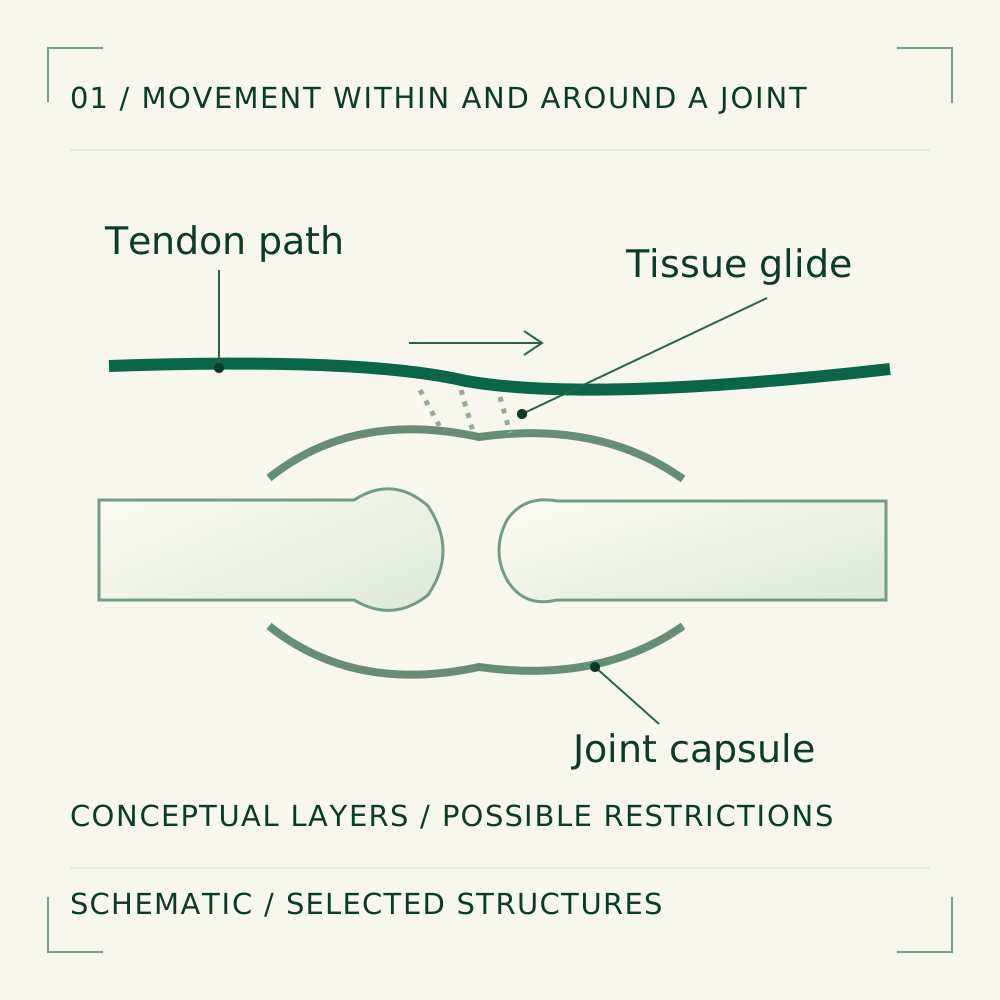
Stiffness means reduced movement, not one diagnosis. A finger may not fully bend or straighten, or the wrist may no longer reach its usual range. The restriction can arise within a joint or from the tendons and other tissues around it.
1Losing the easy reach of the hand
Reduced movement can affect grip, dexterity and personal care. You may struggle to make a fist, straighten a finger or position the wrist for a task. Swelling and tenderness may accompany the restriction, but the degree of pain and the degree of stiffness can differ.
1After injury, protection or an operation
An injured or swollen wrist can become stiff while it is protected and healing. Time in a cast or splint may contribute to reduced movement. Exercises need to respect the injury and the treating team’s restrictions; a healing fracture or repair should not be forced.
2A healed injury can still leave restricted glide
After tendon repair, a fracture or another operation, scar may tether a tendon to surrounding tissues. This can limit finger movement even after the original wound or bone has healed. Not every stiff hand has this problem, so the source of restriction needs examination.
3Different tissues need different approaches
Understanding the problem.
Choosing the next step.
Comparing active and assisted movement
The clinician measures movement you produce yourself and movement available with gentle assistance. The difference can help identify tendon restriction, weakness or joint tightness. Assessment also checks sensation, circulation, swelling and alignment and reviews previous treatment, including what improved symptoms or made them worse.
1Use imaging to answer a specific question
X-rays may show arthritis, an old fracture, altered alignment or a bony block. CT or MRI is reserved for selected questions. The examination remains central because an image alone cannot describe how a tendon glides or how the hand performs an everyday task.
1Guided movement without forcing the joint
Hand therapy may use controlled stretching, mobilisation and functional practice, with attention to swelling and pain. The programme is adjusted to the tissues involved and stage of healing. Exercises should follow individual advice; sharp pain or a significant flare calls for review rather than more force.
2Some splints protect; others help regain range
A resting support and a splint designed to gradually stretch a stiff joint have different purposes. Static-progressive or dynamic devices may be used in selected cases. A therapist monitors fit, pressure, direction of stretch and progress, with a wear schedule matched to the individual problem.
4Only when there is a suitable treatment target
An injection is not a routine answer to loss of movement. It may be discussed when painful joint inflammation contributes to symptoms. Its role is symptom relief; a fixed mechanical restriction or tendon adhesion needs a different assessment and treatment plan.
5Release or reconstruction needs a clear reason
If appropriate therapy has not restored useful movement, surgery may be considered for a defined restriction. Tenolysis releases scar tethering a tendon. Other cases may need release of tight tissues or a joint-specific reconstruction. The possible gain must justify the risks of further scarring, stiffness and damage to nearby structures.
3Rehabilitation is part of the treatment
After a release, carefully timed hand therapy helps maintain the movement gained and reduce renewed adhesions. Progress depends on tissue quality, the duration of stiffness and the original injury. Improvement can take months; full movement is not always achievable, even with appropriate surgery and rehabilitation.
3When progress stalls or function deteriorates
Ask for review if useful movement is not returning, exercises repeatedly cause a significant flare, or daily tasks are becoming harder. The team may need to adjust the therapy programme or reassess the cause. After recent surgery, follow the planned protection and contact arrangements.
202 / JOINT CHANGE THROUGH TIMEPreserving useful movement
Joint
Degeneration
What it is
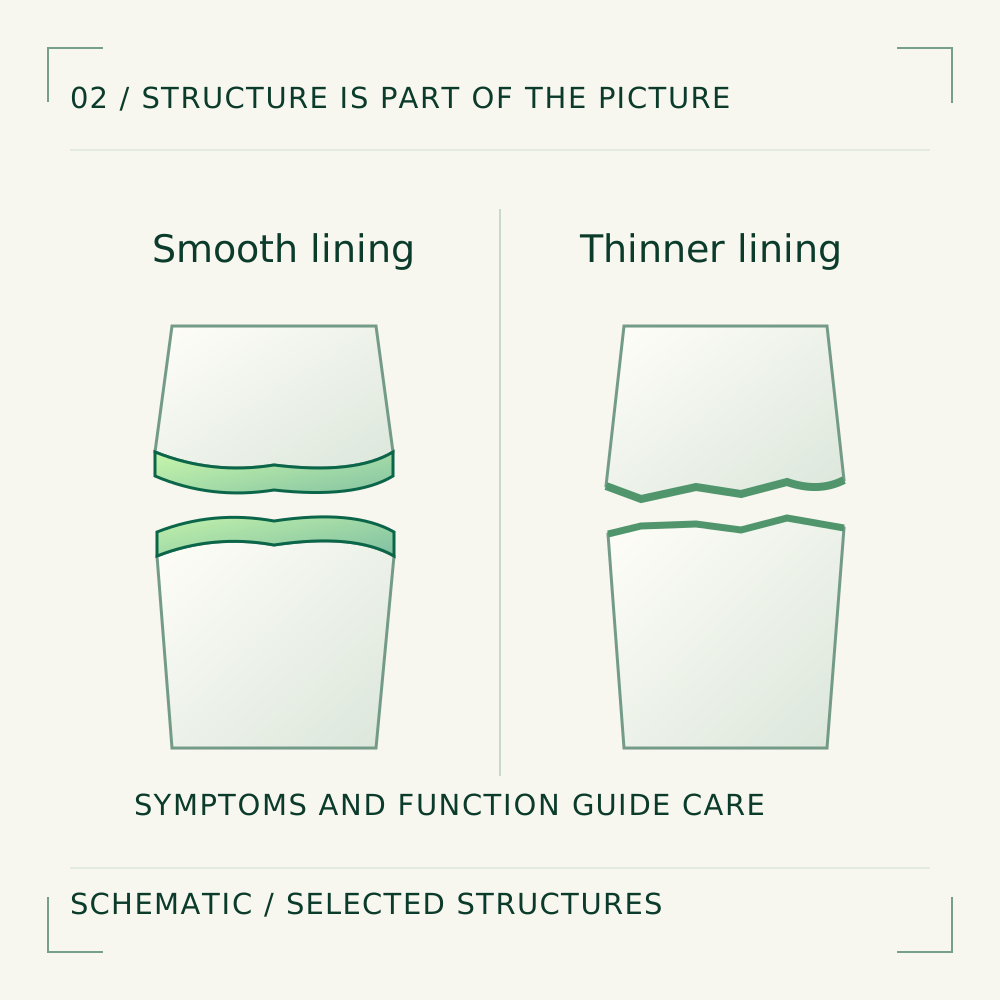
Degenerative joint problems involve changes to cartilage, bone and the tissues that support movement. Osteoarthritis is a common example. The condition can affect how a joint carries load, but the course varies: changes do not necessarily worsen continuously, and symptoms may fluctuate.
6Pain, stiffness and reduced confidence in movement
A joint may ache during use, feel stiff after rest or become swollen. Reduced motion and discomfort can weaken grip and make repeated tasks tiring. The pattern and severity vary between people, and changes can be troublesome even without a striking visible deformity.
6Cartilage and mechanics change together
Progressive cartilage loss can alter the way joint surfaces move and transmit load. Earlier trauma or another joint condition may contribute. Repeated excessive loading can aggravate vulnerable joints, but ordinary hand use alone does not explain every case and should not automatically be blamed.
6Age is one influence, not the whole explanation
The likelihood of osteoarthritis rises with age and family history can play a part. Previous injury may bring symptoms earlier. Progression differs, and a diagnosis does not mean that useful movement will inevitably be lost or that an operation will eventually be necessary.
6Choose goals that matter outside the clinic
Managing symptoms should support the activities you need or value. Opening containers, typing, caring for someone or using tools place different demands on the hand. A useful plan links exercises and practical adjustments to those goals, then reviews whether daily function is improving.
8Understanding the problem.
Choosing the next step.
The history and examination come first
Assessment looks at the distribution of symptoms, movement, tenderness and the pattern of stiffness. Typical osteoarthritis can often be recognised clinically. Unusual features prompt consideration of another or additional cause rather than assuming all hand or wrist pain comes from degeneration.
7Further detail when it will change the plan
Imaging is not always necessary for typical osteoarthritis. X-rays can be helpful when the diagnosis is uncertain or joint-specific surgical planning is needed. Scans are selected for a particular question; repeated imaging is not required simply to measure how every flare feels.
7Exercise, adaptation and suitable symptom relief
A tailored exercise programme supports movement and strength. Changing difficult tasks or using aids can reduce painful strain. Pain relief is selected for your health and other medicines. Remaining usefully active is usually preferable to abandoning movement, with the programme adjusted if symptoms are poorly controlled.
5A limited role, with realistic expectations
A corticosteroid injection may be considered when other suitable measures have not helped or to support exercise. It offers short-term symptom relief, not cartilage repair. The decision is specific to the joint and symptoms; routine or repeated injections are not automatically appropriate.
7Tailor the procedure to the affected joint
Surgery may be discussed when daily life remains substantially affected despite appropriate care. Options can involve removing damaged joint surfaces, fusion or selected replacement, depending on the joint. Preserving useful function is the aim, with explicit discussion of lost movement, rehabilitation and the possibility of continuing symptoms.
8Longer-term care remains individual
Symptoms may improve with a practical treatment programme, although arthritis is a long-term condition. After surgery, recovery depends on the specific procedure and rehabilitation. Neither an operation nor an exercise programme guarantees a pain-free hand or a completely normal range of movement.
5Recognising a different pattern
Prolonged morning stiffness, several persistently swollen joints or symptoms in both hands may suggest an inflammatory condition. These features deserve medical assessment and may require rheumatology care alongside hand surgery input. They should not simply be attributed to ageing or routine wear.
9Review a changing or persistently difficult joint
Seek assessment when symptoms continue to limit everyday movement or the pattern changes. Bring your priorities and a record of treatments already tried. Decisions should reflect the impact on your function and your preferences, rather than an X-ray description alone.
8Sudden severe inflammation needs prompt care
A hot, swollen joint with rapidly increasing pain needs urgent medical review, especially with fever or feeling unwell. Infection is one possible cause and fever is not always present. Treat this as a new problem rather than waiting for an ordinary arthritis appointment.
10THE NEXT CHAPTER / YOUR CARE
When stiffness begins to limit everyday movement, the cause matters.
A specialist assessment can connect your symptoms with the underlying problem and help you weigh personalised treatment options, rehabilitation and the movements that matter to you.
Book a Consultation