03.03 / TENDON & SOFT TISSUE
Dupuytren’s
Disease
A change in the palm can gradually change how a hand opens. Dupuytren’s involves the fascia beneath the skin, rather than an injured tendon. The pattern, progression and effect on daily life guide when treatment is useful.
01 / THE CONNECTIVE TISSUE OF THE PALMFascia & contracture
Dupuytren’s
Disease
What it is
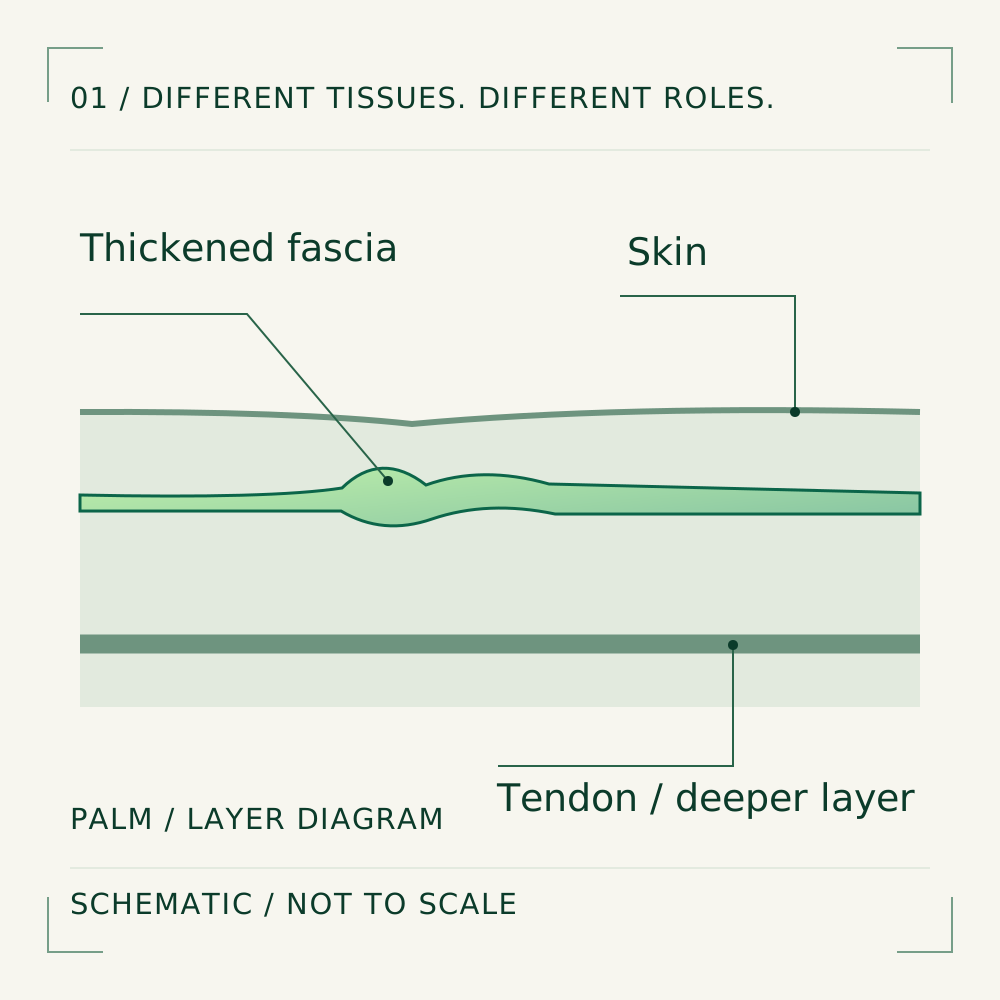
Dupuytren’s affects the palmar fascia, a layer of connective tissue beneath the skin and above the tendons. This tissue can thicken into nodules and cords. If a cord shortens, it may pull a finger towards the palm. This is a fascial condition, not a flexor tendon injury.
1Nodules, cords and loss of straightening
A firm lump may appear in the palm, sometimes with skin dimpling or tenderness at first. Over time a cord may become visible or felt beneath the skin. A finger can gradually lose its ability to straighten, even though bending and grip remain possible.
1A change within the fascia
The exact cause is not fully understood. In susceptible people the fascia thickens and contracts. A cord can feel like a tight tendon, but it arises in a different tissue layer. The appearance of a palmar lump does not by itself establish Dupuytren’s; other causes may need consideration.
3Family history and other associations
The condition is more common with increasing age, in men and in people with a family history, although anyone can be affected. Associations include diabetes, smoking and alcohol use. These are not a complete explanation for an individual case, and manual work is not an established sole cause.
4The pace is different for everyone
The ring and little fingers are often affected, and changes can occur in both hands. Some nodules remain stable for years; others develop into tightening cords. Difficulty putting a hand into a pocket, wearing gloves, washing the face or placing it flat may become more important than pain.
2Understanding the change.
Choosing your care.
Measure change and understand its effect
The specialist examines the palm, feels the cords and records how far each involved joint can straighten. Skin involvement, sensation and the other hand are also assessed. Your account of daily difficulties and how quickly the hand has changed helps guide whether treatment would be useful.
5Most cases need examination rather than scans
Diagnosis is generally clinical. X-rays or other tests are not routinely needed for a typical presentation. If the lump, pain or limitation does not fit the usual pattern, the clinician may investigate another explanation rather than assuming that every palm lump is a Dupuytren’s nodule.
3Observation is an active option
When there is little or no contracture and function is satisfactory, monitoring may be appropriate. Note changes in finger straightening and daily tasks. There is no established stretching or splinting programme that reliably stops untreated disease progressing; forceful stretching should not be used to try to break a cord.
1When treatment becomes worth discussing
Treatment is considered when contracture limits hand use or is progressing. The joint affected, amount of lost extension, skin condition and your priorities all matter. An inability to lay the hand flat is a reason for assessment, not an automatic instruction to have surgery.
2Needle and injection-based approaches
In suitable cords, needle fasciotomy divides the tight tissue through small punctures. Collagenase injection, where available and appropriate, weakens a cord before a planned release manoeuvre. These options have selection limits and recurrence risks. Local availability varies. A steroid injection may sometimes ease a painful nodule, but it does not correct an established contracture.
5Removing the contracted fascia
A limited fasciectomy removes affected fascial tissue to release a contracture. More extensive or recurrent disease may require removal of involved skin with a graft, called dermofasciectomy. The surgeon balances correction with wound healing and the condition of the joints; longstanding stiffness can limit how straight a finger becomes.
4Release does not remove the tendency to develop disease
Treatment addresses an existing contracture. Dupuytren’s can recur in a treated area or appear elsewhere. Recurrence generally occurs more often after needle release than after fasciectomy, but no method guarantees a permanent cure. Recovery time, risks and the chance of repeat treatment belong in the same discussion.
5Benefits must be weighed against the procedure
Potential complications include wound problems, infection, scar sensitivity, stiffness and injury to nerves or blood vessels. The risks differ with the procedure and severity of disease. Discuss the likely functional gain and the possibility of residual contracture, rather than assuming every finger can return to its previous position.
3A hand therapy plan supports recovery
After treatment, wound care, swelling control and guided movement help the hand recover useful function. A splint may be recommended for selected patients, particularly after an operation; it is not automatically required for everyone. Therapy and follow-up are tailored to the procedure, correction and individual stiffness.
4Different procedures have different recovery demands
Needle treatment generally permits an earlier return to use than open surgery, which leaves a larger healing wound. Work and hobbies resume according to wound recovery, comfort and safe function. A demanding grip task can need longer than light use. Discuss practical arrangements before choosing a procedure.
5When specialist assessment is recommended
Arrange review if a finger is increasingly bent, the hand no longer rests flat or ordinary tasks are becoming difficult. New or uncertain palm lumps should also be checked. A gradually developing cord is not usually an emergency, but persistent functional change deserves a clear diagnosis and discussion of options.
2THE NEXT CHAPTER / YOUR CARE
When the hand no longer opens as it used to.
A specialist assessment can clarify the tissue involved, measure the change and discuss observation or treatment in the context of your everyday hand function.
Book a Consultation